PA school compresses two years of physician-level content into a format that demands a completely different study system than undergrad. You're memorizing organ systems, disease entities, pharmacology, clinical management algorithms, and PANCE blueprint categories simultaneously — often while completing rotations. Flashcards remain the most effective tool for that kind of high-volume, high-stakes memorization, but the app you choose matters more than most students realize.
This guide compares the best flashcard apps for PA school in 2026, focused on what actually matters for PANCE performance.
What PA Students Actually Need from a Flashcard App
Most flashcard apps were built for vocabulary review, not medical school-level content loads. PA students have specific requirements that most apps don't meet:
Spaced repetition that scales to 1,000+ cards. PANCE prep spans 13 content areas — cardiology, pulmonology, GI, neurology, orthopedics, and more. A serious deck runs well over a thousand cards. You need an algorithm that tracks your exact memory state for each card, not a timer that gives every card the same interval. FSRS (Free Spaced Repetition Scheduler) is the most accurate scheduling algorithm available in 2026 and is measurably more efficient than the older SM-2 system used by most flashcard apps.
Fast deck creation from lecture and disease entity notes. PA programs move fast. An app that generates flashcards from pasted lecture notes or disease entity summaries can save hours per week — especially during rotation months when dedicated study time is scarce.
Audio for drug name and clinical term pronunciation. Clinical rotations require you to communicate clearly with attendings, nurses, and patients. Hearing drug names and clinical terminology during review helps build the pronunciation confidence you can't get from silent reading.
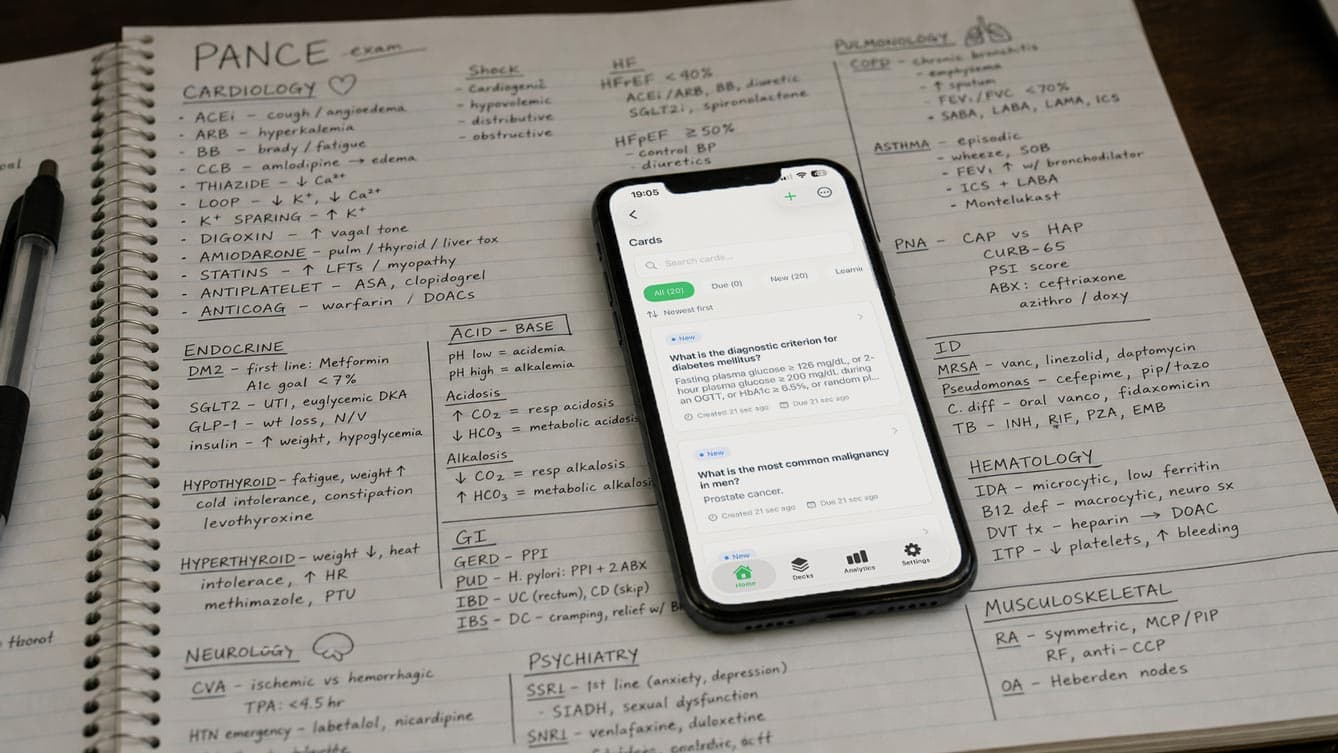
AnkiHub import. The PA community has built shared Anki decks for organ systems, pharmacology, and PANCE prep. Your app needs to import .apkg files without losing card formatting or images.
Offline access. Hospital floors, rural clinics, and rotation sites don't always have reliable WiFi. Your study sessions can't depend on a connection.
Best Flashcard Apps for PA School in 2026
MintDeck — Best for PANCE Prep
MintDeck is an iPhone-first flashcard app built around FSRS spaced repetition. It was designed to address exactly what PA and medical students find frustrating about Anki (steep learning curve, dated interface) and Quizlet (no real spaced repetition, paywalled features).
Why it works for PA students:
- FSRS scheduling — The algorithm calculates your current memory retention for each card and schedules the review at the optimal moment. For 1,000+ organ system and pharmacology cards, this is the difference between material that sticks through PANCE and material that fades under pressure.
- AI deck generation — Paste disease entity notes, a drug class list, or a clinical management summary and MintDeck generates structured flashcards in seconds. New users get 10 free AI credits to start.
- Free audio in five languages — On-device text-to-speech works offline for English, French, Spanish, Portuguese, and Korean. Hear drug names and clinical terminology during commutes, between patients, or while cooking. Pronunciation practice is built into every review session.
- AnkiHub import — Import
.apkgfiles directly, with media, formatting, and scheduling data preserved. Your existing PA community decks come over intact. - Offline support — All study sessions and FSRS scheduling work without internet. Only AI generation requires a connection.
MintDeck is free to download. FSRS scheduling, import, and audio are fully free. AI generation uses a credit system (10 free credits on signup; additional credits from $1.99).
Anki + AnkiHub
Anki is the most powerful flashcard ecosystem available, and it matters for PA students because of AnkiHub's community content. High-quality PA-specific shared decks covering organ systems, pharmacology, and PANCE blueprint categories exist on AnkiHub — and many programs informally recommend them.
The downsides in 2026: AnkiMobile on iPhone costs $24.99. The interface is functionally unchanged from a decade ago. Configuring deck options, sync settings, and media handling takes meaningful time — often during the weeks of PA school when you can least afford it.
For students already using AnkiHub decks, MintDeck's .apkg import is worth knowing about. You can bring those same decks into a modern iOS interface with FSRS scheduling already built in, without paying $24.99 for AnkiMobile.
Best for: Students already invested in AnkiHub community decks who don't mind the $24.99 iPhone cost and configuration overhead.
Quizlet
Quizlet has the largest library of user-created PA school content, and its familiarity makes it a default for many students. The core problem: Quizlet doesn't have FSRS — or any meaningful spaced repetition algorithm. Learn mode, which was its main study feature, is now paywalled at $2.99/month.
For PANCE prep specifically, the absence of spaced repetition is a serious limitation. Board exams test retrieval under pressure — that retrieval strength only builds through properly spaced review, not repeated exposure or shuffle mode.
Best for: Quick reference look-ups of existing PA content. Not recommended as a primary PANCE prep tool.
Brainscape
Brainscape uses a confidence-based system where you self-rate each card 1–5 after reviewing. It's intuitive and has some pre-made medical and pharmacology decks. The free tier is limited (capped decks, no offline access), and the algorithm doesn't match FSRS efficiency at the card volumes PA school demands.
Best for: Short-term review or supplemental practice. Not a replacement for FSRS-based prep at PANCE scale.
Feature Comparison for PA Students
| Feature | MintDeck | Anki/AnkiHub | Quizlet | Brainscape |
|---|---|---|---|---|
| FSRS spaced repetition | ✅ | ✅ (added v23.10) | ❌ | ❌ |
| Free on iPhone | ✅ | ❌ ($24.99) | ✅ (limited) | ✅ (limited) |
| AI deck generation | ✅ (10 free credits) | ❌ | ❌ | ❌ |
| AnkiHub / .apkg import | ✅ | N/A | ❌ | ❌ |
| Free clinical audio | ✅ (5 languages) | ❌ | ❌ | ❌ |
| Offline study | ✅ | ✅ | ❌ | ❌ |
| Modern iPhone UI | ✅ | ❌ | ✅ | ✅ |
How to Set Up MintDeck for PANCE Prep
Getting started takes about 10 minutes:
- Download MintDeck from the App Store (free)
- Import your AnkiHub PA decks — export as
.apkgfrom Anki desktop, then open in MintDeck. Scheduling data transfers over. - Use your 10 welcome AI credits to generate organ system or pharmacology decks from your program's disease entity notes. Paste the content and MintDeck structures it into card format.
- Enable audio for any deck with drug names or clinical terminology — MintDeck reads cards aloud using on-device TTS, so you can review during commutes or between rotations.
- Let FSRS handle daily scheduling — the algorithm identifies which cards are at risk of being forgotten and surfaces them before your memory fades, keeping your review load manageable even across 13 PANCE content areas.
For a deeper look at how spaced repetition maps to exam performance, see the science of spaced repetition and how we've seen it applied by nursing and medical students and pharmacy students.
Where PA Students Discuss Flashcard Apps
The PA school community is active on Reddit. If you want candid recommendations from students currently in didactic or clinical year:
- r/PAstudents (117K members) — didactic and clinical year discussion, deck recommendations, and PANCE prep strategies
- r/physicianassistant (155K members) — broader PA career discussion with an active student section
Search those communities for threads on PANCE prep, AnkiHub for PA school, and organ system decks. You'll find real student opinions on what's actually working in 2026 — including which shared decks are worth importing.
The Bottom Line
For PANCE prep and PA school organ system mastery, MintDeck is the best flashcard app for iPhone in 2026. It's the only free option that combines FSRS spaced repetition, AnkiHub import, AI deck generation, and clinical audio in a modern iOS interface. Quizlet's paywall changes and AnkiMobile's $24.99 price tag have pushed PA students to look for alternatives — this is the one built for the content volume and retention demands that PANCE actually requires.
PANCE testing peaks May through July. If you're sitting boards this season, now is the time to lock in your review system.