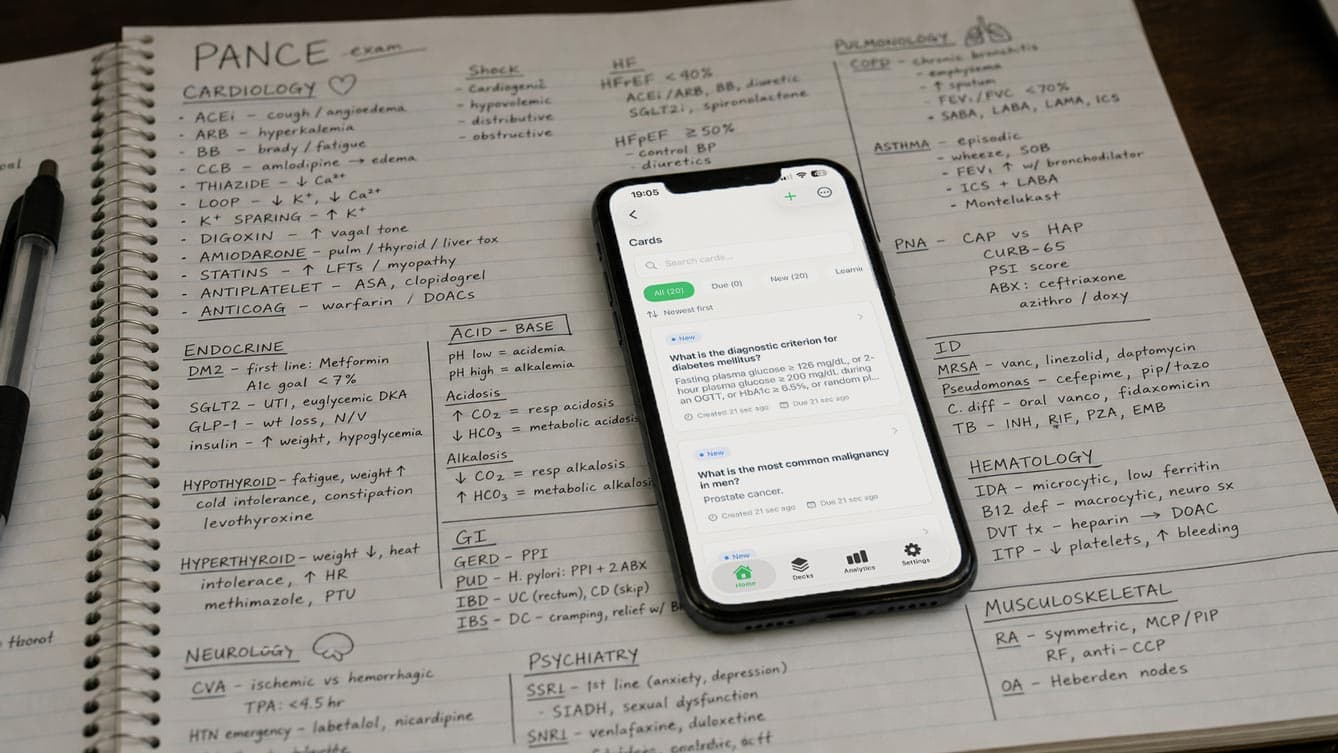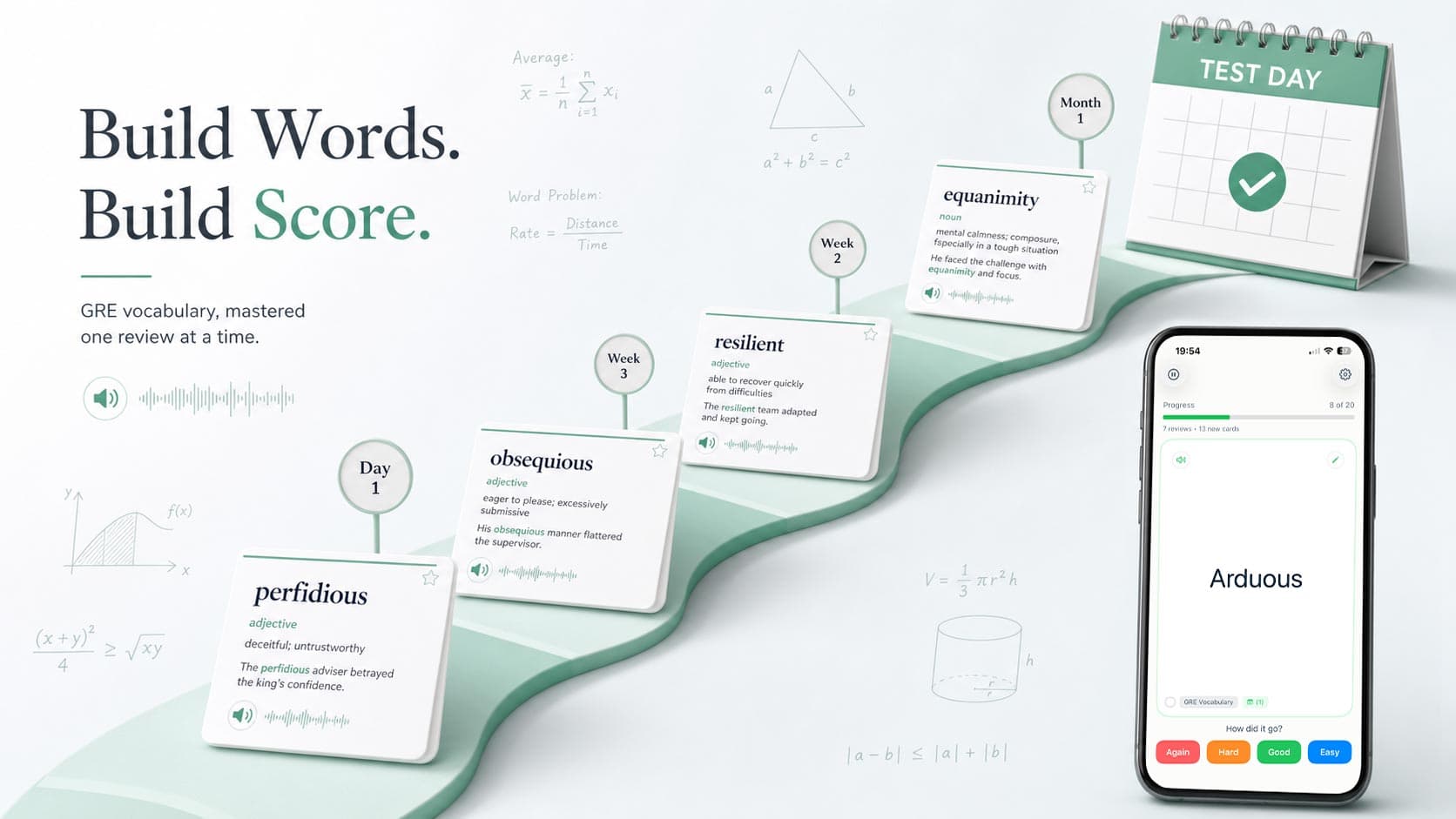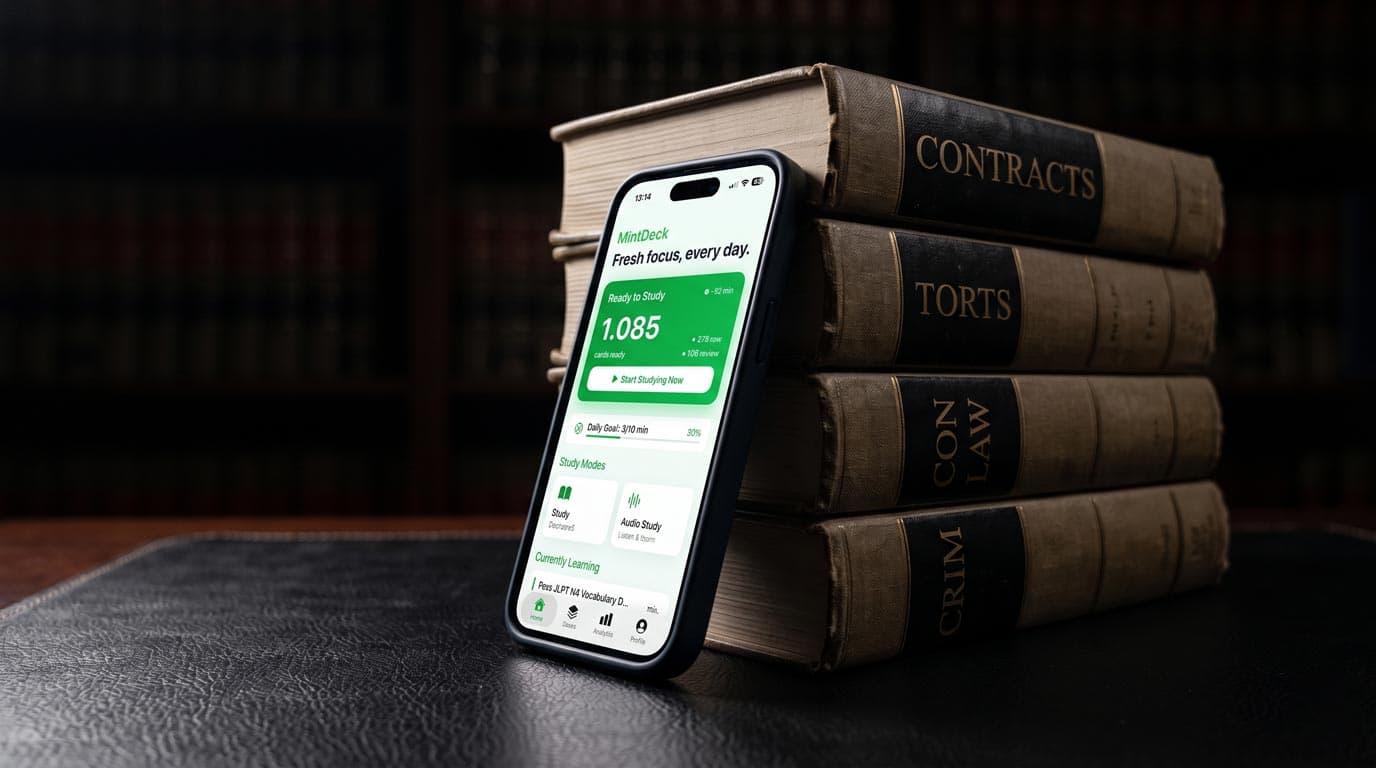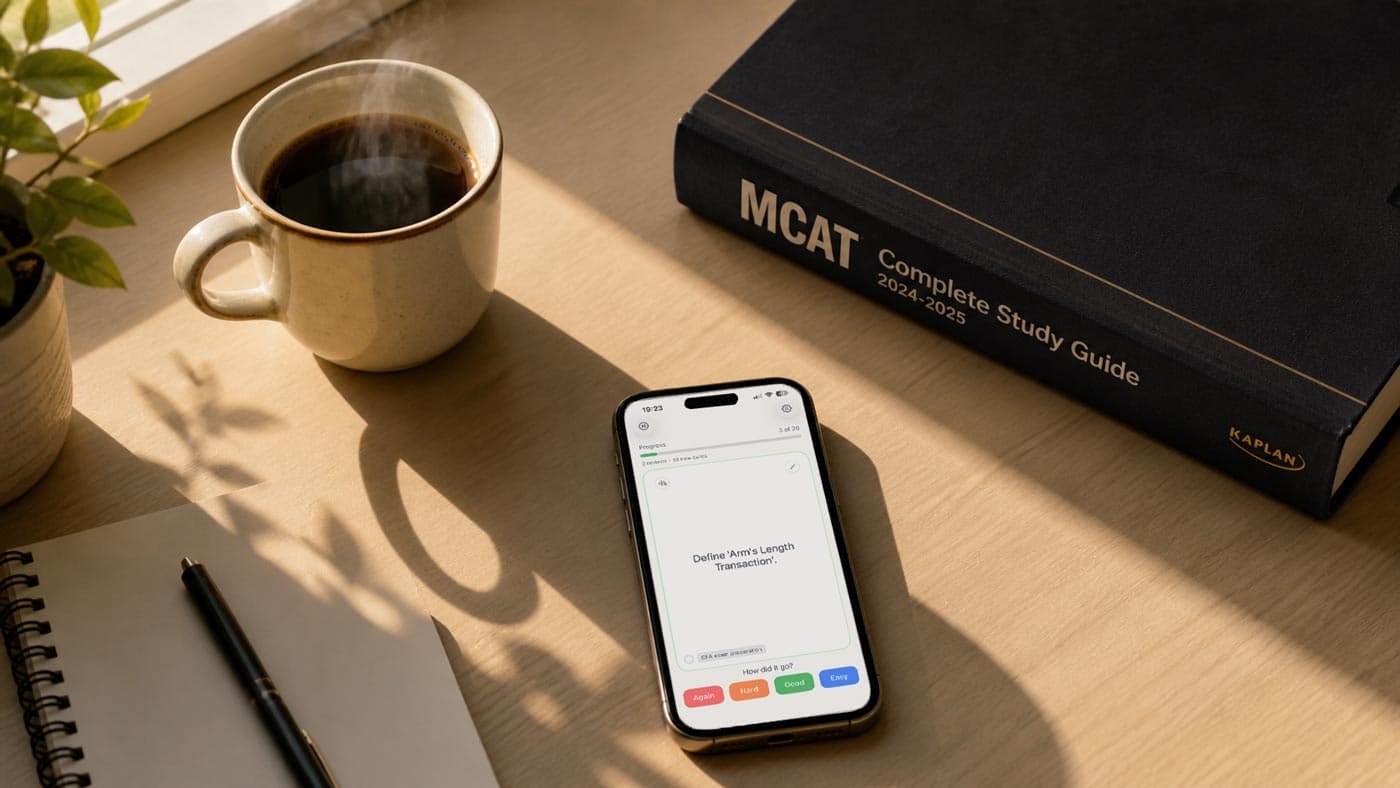
CFA Level 1 covers 10 topic areas — Quantitative Methods, Economics, Financial Statement Analysis, Corporate Issuers, Equity, Fixed Income, Derivatives, Alternative Investments, Portfolio Management, and Ethics. The curriculum runs to 3,600 pages. The August 2026 exam is roughly 90 days away.
Spaced repetition flashcards are the most efficient way to memorize the definitions, formulas, and frameworks that make up around 40–50% of CFA Level 1 questions. But the flashcard app you choose matters — especially for a content load this size.
This guide compares the best flashcard apps for CFA Level 1 in 2026, focused on what actually works at curriculum scale.
What CFA Candidates Need from a Flashcard App
CFA Level 1 has specific requirements that most flashcard apps aren't designed for:
Spaced repetition that handles hundreds of formula cards. Quantitative Methods alone has dozens of formulas — time value of money, statistical measures, hypothesis testing, regression. Ethics requires near-verbatim recall of Standards. A scheduler that gives every card the same interval fails you at this volume. FSRS (Free Spaced Repetition Scheduler) is the most accurate scheduling algorithm available in 2026 — it tracks your memory state per card and schedules each review at the exact point before forgetting, not on a fixed timer.
AI generation from your own study materials. Unlike USMLE or NCLEX prep, there are no well-established AnkiHub community decks for CFA — the curriculum is updated annually and the candidate community doesn't maintain shared decks the way medical students do. This makes AI generation from your own Schweser notes or CFA Institute readings the most practical deck-building workflow available.
PDF-to-flashcard conversion. Most CFA candidates work from Schweser PDFs or printed CFA Institute chapter PDFs. An app that accepts pasted text from those sources and converts it to card format removes the biggest friction point: the time cost of creating cards by hand.
Offline access. Library sessions, commutes, and exam-center waiting rooms don't guarantee WiFi. Your review schedule should work without it.
Best Flashcard Apps for CFA Level 1 in 2026
MintDeck — Best for CFA Formula and Concept Memorization
MintDeck is an iPhone-first flashcard app built around FSRS spaced repetition and AI deck generation. It was designed for exactly the problem CFA candidates face: high-volume, high-stakes memorization from a dense, text-and-formula-heavy curriculum with no pre-built community deck library.
Why it works for CFA prep:
- FSRS scheduling — For a 10-topic curriculum with hundreds of formula cards and conceptual definitions, FSRS calculates your current retention for each card and surfaces it at the right moment. Stronger cards get longer intervals. Cards you're weak on get reviewed more often. At 500+ cards across topics, the difference between FSRS and a fixed-interval system is measurable — fewer reviews wasted on cards you already know, more focused attention on the ones you're about to forget.
- AI deck generation from study notes — Paste a section from your Schweser summary or CFA Institute chapter, and MintDeck generates a structured set of flashcards in about 30 seconds. This is the fastest way to convert reading notes into a review system. New users get 10 free AI credits to start.
- Formula card workflow — Atomic cards work especially well for CFA Quant: one formula front, definition and derivation on the back. Build topic-specific decks (Quant, FRA, Ethics) as you complete each reading, then let FSRS merge them into a unified daily review schedule as the exam approaches.
- PDF-to-card conversion — For a detailed walkthrough of converting study PDFs into flashcard decks, see the PDF to flashcards guide. Trim chapters before pasting to keep card density manageable.
- Free audio — On-device text-to-speech works offline in five languages. Useful for drilling terminology during commutes or walking through formula definitions hands-free.
- Offline study — All FSRS scheduling and review sessions work without a connection. Only AI generation requires the internet.
MintDeck is free to download. FSRS scheduling and audio are fully free. AI generation uses credits (10 free on signup; additional credits from $1.99).
Start building your CFA deck free →
Anki
Anki is the most technically capable flashcard system available, and it supports FSRS (added in version 23.10). The challenge for CFA candidates specifically: there are no maintained AnkiHub community decks for CFA the way there are for USMLE (AnKing) or NCLEX. You're building your own deck either way.
That shifts the comparison. If you're building from scratch, Anki's setup overhead — deck options, sync configuration, add-ons — becomes a cost without the payoff of importing pre-built community content. AnkiMobile on iPhone costs $24.99. The desktop version is free, but an iPhone-only review workflow isn't well-supported.
For candidates already using Anki on desktop with a working CFA deck, continuing that workflow makes sense. For candidates starting fresh in 2026, the setup cost vs. MintDeck's day-one usability is a real comparison point.
Best for: Candidates already running an established Anki workflow who don't need AI generation.
Quizlet
Quizlet has a large library of user-generated CFA flashcard sets that cover individual topics and readings. Discovery is fast and the interface is clean. The core limitation: Quizlet doesn't use spaced repetition with a meaningful scheduling algorithm. Learn mode, which was its primary study feature, is now paywalled at $2.99/month.
For CFA Level 1 specifically, the absence of a real spaced repetition algorithm matters. Passing the exam requires reliable retrieval under time pressure — that retrieval strength builds through properly spaced review, not shuffle mode or repeated exposure to the same card sequence.
Best for: Browsing pre-made CFA sets for initial topic exposure. Not recommended as a primary review tool at exam-prep scale.
Brainscape
Brainscape has official CFA Level 1 content created in partnership with review providers. The confidence-rating system (1–5 after each card) is intuitive and better than no scheduling at all. The free tier is limited, and Brainscape Pro is $9.99/month — over a 6-month study period, that's $60 before you've bought any study materials.
The algorithm doesn't match FSRS efficiency at 500+ card volume, and you can't import your own notes or AI-generate custom decks from your specific Schweser summaries.
Best for: Candidates who want pre-built CFA content and don't mind the monthly subscription. Not ideal if you want to build decks from your own reading notes.
Feature Comparison for CFA Candidates
| Feature | MintDeck | Anki | Quizlet | Brainscape |
|---|---|---|---|---|
| FSRS spaced repetition | ✅ | ✅ (v23.10+) | ❌ | ❌ |
| Free on iPhone | ✅ | ❌ ($24.99) | ✅ (limited) | ✅ (limited) |
| AI deck generation | ✅ (10 free credits) | ❌ | ❌ | ❌ |
| CFA community decks | ❌ (none exist) | ❌ (none exist) | ✅ (user-created) | ✅ (official) |
| PDF / notes to cards | ✅ | Manual only | Manual only | Manual only |
| Free offline study | ✅ | ✅ | ❌ | ❌ |
| Modern iPhone UI | ✅ | ❌ | ✅ | ✅ |
| Monthly subscription | ❌ | ❌ | $2.99/mo | $9.99/mo |
How to Set Up MintDeck for CFA Level 1
A practical workflow for the August exam:
- Download MintDeck from the App Store (free)
- Organize by topic area — create a deck for each of the 10 CFA topics. Keeping topics separate lets you track weak areas by deck and weight your daily review accordingly
- Use AI generation per reading — as you complete each Schweser chapter or CFA Institute reading, paste your summary notes and use AI credits to generate the deck. 10 free credits is enough to cover your first 2–3 topic areas
- Build formula cards manually for Quant — for time value of money, statistical formulas, and hypothesis testing, create atomic cards by hand: formula on the front, derivation and interpretation on the back. These are too precise for AI generation alone
- Let FSRS schedule across all decks — once your decks are built, FSRS creates a unified daily review queue that balances all 10 topics. By the final 30 days before the exam, you'll be reviewing the cards at highest risk of forgetting, not the ones you already know
For more on how spaced repetition maps to high-stakes exam performance, see the science of spaced repetition and the guide to studying with AI-generated flashcards.
The CFA Community on Reddit
The main CFA study community is r/CFA (194K members) — active threads on study plans, topic weightings, and tool recommendations from candidates at every level. Search for flashcard threads to see what's working for the August cohort.
The Bottom Line
For CFA Level 1 in 2026, the combination of FSRS scheduling and AI generation from your own study materials is the most efficient available workflow — and MintDeck is the only free iPhone app that offers both. Quizlet's paywall changes and Anki's $24.99 iPhone price have pushed CFA candidates toward alternatives; Brainscape's pre-built content is useful but the subscription adds up during a 6-month study window.
The August 2026 exam window is open. If you're still building your review system, now is the time to lock it in — not during the final 30-day sprint when you need that system to be automatic.