The Science of Memory: How Spaced Repetition Helps You Learn Faster
Why You Forget What You Just Learned (And What to Do About It)
You spend two hours studying for an exam. You feel confident walking in. By the time you sit down, though, something strange happens: half the material has vanished from your mind.
This isn't a failure of your memory or intelligence. It's a predictable pattern of forgetting documented for over 140 years—and there's a science-backed solution that can change how you learn forever.
The Forgetting Curve: What Hermann Ebbinghaus Discovered in 1885
Long before smartphones and AI, German psychologist Hermann Ebbinghaus wanted to understand one fundamental question: How quickly do we forget?
So he did something unusual. He memorized meaningless syllables—"ZEK," "DAX," "WOL"—and then tested himself at various intervals to measure how much he retained over time. What he discovered became the foundation for modern learning science.
His finding was stark: Without active effort to retain information, we forget approximately 50% of newly learned material within one hour, and up to 70% within the first day.
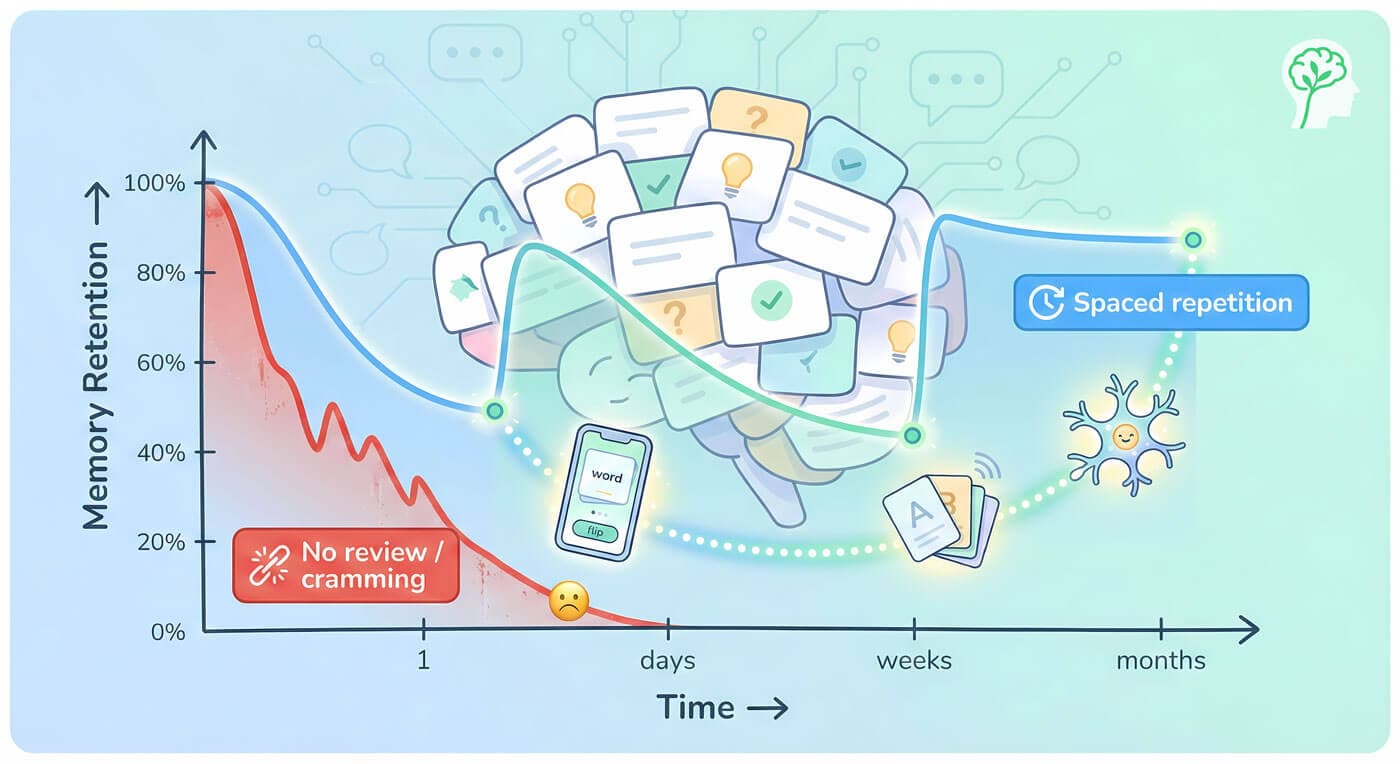
Ebbinghaus visualized this pattern as a curve—now called the forgetting curve—that showed how memory retention plummets steeply in the hours and days after learning, then gradually levels off. The shape looks like a cliff that becomes a shallow slope.
But here's what made Ebbinghaus's research truly revolutionary: He discovered that each time you review material, the curve flattens.
When you revisit information after forgetting some of it, your memory doesn't just return to baseline—it strengthens. The next time you forget, it takes longer. Each review session compounds, pushing the forgetting curve further into the future. Eventually, you can wait weeks, then months, then years between reviews and still retain the information.
This observation led to one of the most powerful learning techniques ever discovered: spaced repetition.
The Spacing Effect: Why Spreading Out Study Sessions Beats Cramming
Spaced repetition isn't just a personal hack. It's backed by what researchers call the spacing effect—one of the most robust findings in learning science, replicated in hundreds of studies across over a century.
The evidence is overwhelming: spreading your study sessions across time with gaps between them dramatically outperforms cramming everything into one intensive session.
Consider the numbers:
- After 150 weeks: Students using spaced repetition retained 82% of material, while students who crammed retained only 27%
- Improvement factor: Spaced repetition improves long-term retention by approximately 200% compared to massed practice (cramming)
- Meta-analysis: A 2021 meta-analysis of 242 studies with over 169,000 participants confirmed that distributed practice consistently emerges as one of the most effective learning techniques, with effect sizes well above the educational research average
Yet here's the paradox: Cramming feels more effective, even when it isn't.
When you cram, information becomes temporarily familiar. You can recognize it easily during your study session. This familiarity creates a psychological illusion—you feel like you've mastered the material. Cognitive psychologists call this the fluency illusion.
But recognition is not recall. Your brain processes familiarity (visual recognition) in different regions than it processes recall (which relies on the frontal cortex and temporal lobe). Cramming primarily activates familiarity-based processing, which is why material feels accessible during your study session but becomes unretrievable when you actually need it—like during an exam.
Research by Karpicke and Roediger at Washington University demonstrated this clearly: students' predictions of their own performance were essentially uncorrelated with their actual performance after spacing and testing. Students consistently overestimated how much they'd learned from massed study.
Why Spaced Repetition Works: The Neuroscience Behind Memory
Understanding the mechanics of why spaced repetition works reveals the brilliance of the learning process itself.
Synaptic Plasticity and Long-Term Potentiation
When you learn something new, your brain creates connections between neurons. These connections, called synapses, transmit signals through neurotransmitters.
Research by neurobiologists Christine Gall and Gary Lynch at UC Irvine revealed something crucial: Synapses encode memories more effectively when activated briefly and repeatedly, rather than continuously. In their studies with mice trained over multiple short sessions spaced one hour apart, performance was significantly better than mice trained in a single prolonged session.
As Lynch explained it: "It's as if your brain is working at full power."
Each repeated activation strengthens the synapses through a process called long-term potentiation (LTP)—essentially the prolonged strengthening of synaptic transmission. This process increases neurotransmitter production and receptor sensitivity, lasting from minutes to even days. LTP is considered one of the best-understood cellular processes underlying memory formation and synaptic plasticity.
Memory Consolidation: From Temporary to Permanent Storage
When you first learn something, it exists in fragile, temporary form. Through spaced repetition, this temporary memory gets consolidated into lasting long-term storage—a process that spans multiple brain regions.
Memory consolidation works in stages:
- Synaptic consolidation (minutes to hours): The initial encoding phase where synapses strengthen
- Systems consolidation (days to years): The memory gradually transfers from the hippocampus (temporary storage) to the neocortex (permanent storage)
This transfer process is why sleep matters for learning. One of the major theories of sleep suggests it facilitates this consolidation by processing and reorganizing information acquired during waking hours. During sleep, your brain reactivates recently learned memories, strengthening them and embedding them into long-term storage.
Encoding Variability and Effortful Retrieval
Spaced repetition also works through multiple cognitive mechanisms:
- Encoding variability: When study sessions are spaced apart, you encounter the material in different contexts and mental states. This contextual variation provides richer encoding than massed learning, where everything occurs in one mental state
- Effortful retrieval: The longer the gap between reviews, the more effort your brain must exert to recall the information. This struggle—rather than being a problem—is actually the mechanism that strengthens memory
This is why spacing with expanding intervals (gradually increasing gaps between reviews) works better than spacing with fixed intervals. Each expanded interval makes retrieval slightly harder, forcing your brain to engage more deeply with the material.
Cramming vs. Spaced Repetition: A Head-to-Head Comparison
| Factor | Spaced Repetition | Cramming |
|---|---|---|
| Short-term retention | Good but not immediate | Excellent (illusion of mastery) |
| Long-term retention (weeks/months) | 82% after 150 weeks | 27% after 150 weeks |
| Total study time needed | Often less time for equivalent results | More time wasted relearning forgotten material |
| Neural mechanism | Multiple synapses activated; deep encoding | Single set of synapses; shallow encoding |
| Metacognitive accuracy | Student predictions correlate with actual performance | Students overestimate performance; fluency illusion |
| Transfer to new problems | Strong; deeper understanding | Weak; surface-level familiarity |
| Exam performance | Significantly higher | May pass but doesn't transfer to application |
| Long-term knowledge retention | Years or permanent | Fades within days/weeks |
Active Recall: The Essential Component of Spaced Repetition
Spaced repetition alone isn't enough. Timing is only half the equation. The other half is active recall—forcing your brain to retrieve information without looking at your notes.
Active recall means:
- Taking a topic you want to learn and creating questions based on it
- Repeatedly testing yourself on those questions
- Resisting the urge to immediately peek at the answer
For more techniques that complement spaced repetition, see our guide on 10 scientifically proven study techniques.
Research consistently shows that active recall combined with spaced repetition dramatically outperforms passive rereading. In a classic 2006 study on the testing effect, researchers demonstrated that retrieval practice produces better long-term retention than additional study—especially after a delay.
College studies have shown this clearly: psychology students taught to create and use flashcards with active recall scored significantly higher on exams than students who didn't use the technique. The research suggests that this "easily implemented learning strategy can help students achieve deeper levels of processing, such as comprehension and application, in a self-directed manner."
Flashcards are so effective precisely because they force active recall. By covering the answer and forcing yourself to retrieve information from memory, you engage the neural mechanisms that consolidate learning into long-term storage. Each successful retrieval strengthens the pathways to that knowledge.
From Theory to Practice: How Modern Spaced Repetition Apps Work
Understanding the science is one thing. Implementing it efficiently is another.
Traditional approaches to spaced repetition relied on fixed schedules. If you learned a card on day one, you'd review it on day 3, day 7, day 14, day 30, and so on—a rigid framework that treats everyone's memory the same way.
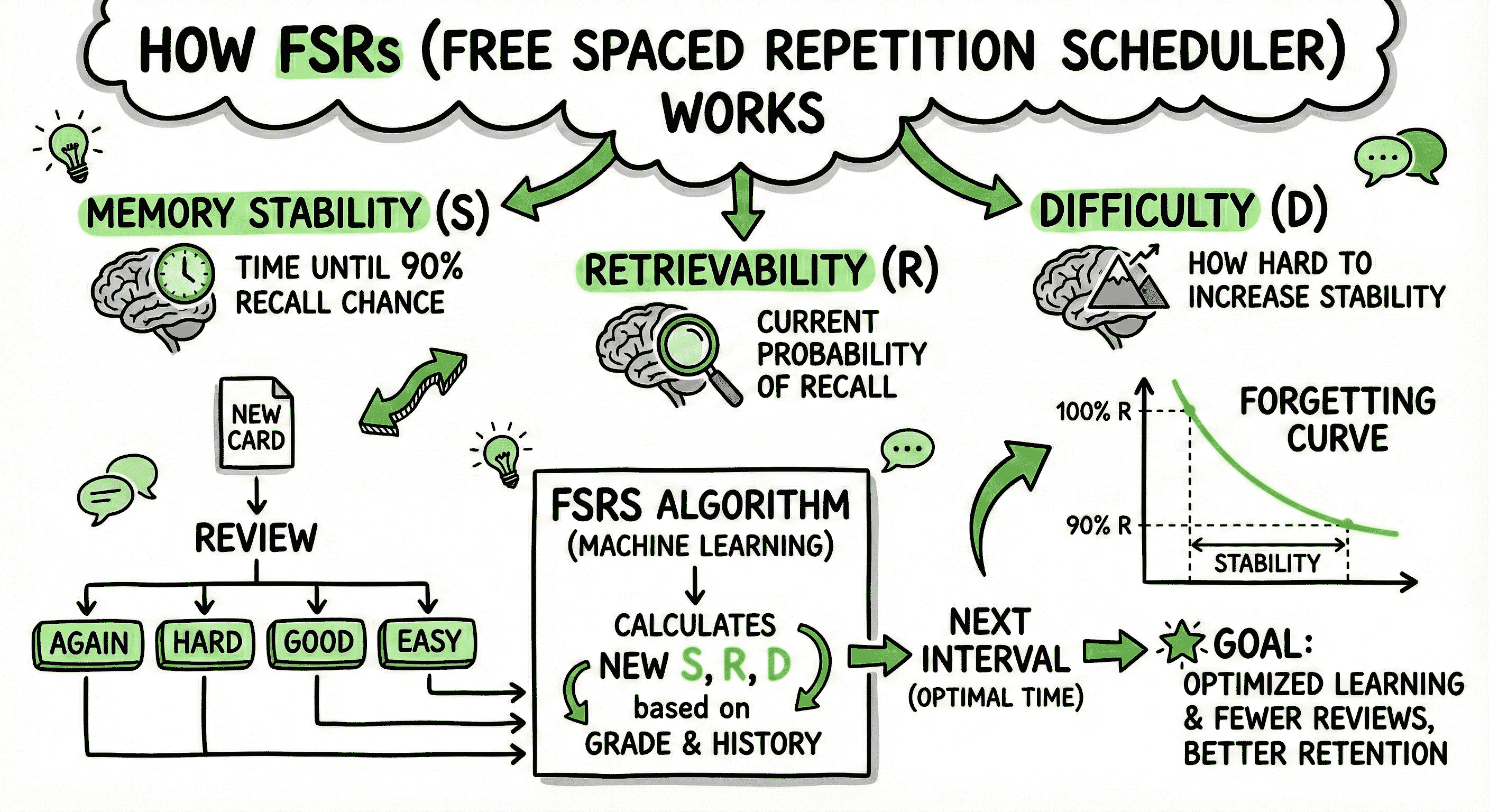
Enter FSRS (Free Spaced Repetition Scheduler), a next-generation algorithm that brings machine learning to spaced repetition. Unlike older systems like SM-2 or basic Anki schedules, FSRS doesn't follow fixed formulas. Instead, it learns your unique memory patterns and adapts in real-time.
How FSRS Works: Personalized Memory Models
FSRS tracks three key memory factors for each card and each learner:
-
Memory Stability (S): How long you can retain information after learning it (measured in days). If your stability is 365, it means the card will decay from 100% recall probability to 90% in one year.
-
Retrieval Strength (R): How easily you can recall information right now—essentially your recall probability on any given day.
-
The Spacing Effect: How the timing and history of reviews affects your memory.
By analyzing data such as how long you take to respond, your accuracy rate, the difficulty of material, and previous intervals, FSRS generates a memory decay curve unique to each user and each item. This personalized curve predicts when you're most likely to forget the information—and therefore when you should review it.
The practical result? FSRS ensures you see difficult material more frequently and easier material less frequently, maximizing retention while minimizing wasted effort. Studies show that FSRS:
- Requires fewer reviews for equivalent retention compared to traditional SM-2
- Delivers more accurate predictions of optimal review timing
- Adapts dynamically as your learning patterns change
This represents a major upgrade from systems that rely on static formulas. Your learning isn't static—it shouldn't be. FSRS meets you where you are.
How MintDeck Implements Science-Backed Learning
MintDeck, a modern flashcard app, brings this research directly into your pocket by building spaced repetition on top of FSRS—the most advanced scheduling algorithm available.
Here's how MintDeck translates memory science into practice:
FSRS Algorithm at the Core
Instead of generic fixed intervals, MintDeck uses FSRS to create personalized review schedules. The app learns your memory patterns and adjusts review timing uniquely for each card. A difficult concept you struggle with gets reviewed frequently, while material you've already mastered can wait longer before the next review.
Active Recall Through Difficulty Rating
MintDeck integrates active recall into its study sessions. After each card, you rate its difficulty on a scale. This feedback doesn't just satisfy curiosity—it directly feeds into FSRS, which recalibrates your schedule based on your actual performance. Your ratings tell the algorithm which cards need more attention and which you're mastering.
Hands-Free Learning with Audio Mode
The science is clear: spaced repetition requires consistent review. But not everyone has time to sit with flashcards.
MintDeck addresses this with audio study mode—high-quality text-to-speech that lets you study during commutes, workouts, or household tasks. Research on distributed practice shows that reviewing material in different contexts (auditory while running, visual while at a desk) provides the encoding variability that strengthens long-term memory. Hands-free study removes friction and makes spacing consistent.
Seamless Import from Anki
Switching learning tools creates a barrier. MintDeck eliminates this by offering full Anki .apkg support, including scheduling data and all media. You bring your existing study materials and their review history. No starting over. This reduces switching friction for Anki users who want to experience FSRS-powered scheduling.
Memory Consolidation Through Sync
Memory consolidation happens over time, often aided by sleep and rest between study sessions. MintDeck's CloudKit sync ensures your progress is preserved seamlessly across iPhone and iPad. Study on your phone during a commute, then continue on your iPad in the evening. Your learning history—the foundation of spaced repetition—travels with you.
Content-to-Deck Transformation
Creating quality flashcards is the bottleneck for many learners. MintDeck offers PDF processing and AI-powered deck generation. Describe a topic or upload course materials, and the app structures content into effective flashcards. This removes the friction that prevents consistent spacing—you get started faster.
Practical Tips: How to Maximize Spaced Repetition
Understanding the theory is useful. Applying it effectively is what matters.
Start with Difficulty-Based Scheduling
Let your spaced repetition algorithm do what it does best: optimize timing. Don't try to create your own review schedule. Instead, focus on honest difficulty ratings. If you struggled to recall something, mark it as "Again" or "Hard." If it was easy, mark it appropriately. The algorithm learns from this feedback and adjusts.
Create Cards That Force Retrieval
Passive flashcards that just show definitions don't trigger active recall. Effective flashcards frame concepts as questions or scenarios:
- Instead of: "Front: Mitochondria | Back: Powerhouse of the cell"
- Use: "Front: What organelle produces ATP through aerobic respiration? | Back: Mitochondria"
The question forces your brain to retrieve specific knowledge rather than recognize a familiar term.
Study Multiple Subjects in One Session
Interleaving different subjects creates encoding variability. Studying Spanish vocabulary, calculus problems, and history facts in one session (rather than batching each subject) engages more neural pathways for each concept. Research shows interleaving improves transfer to new problems.
Review Within 24 Hours of Initial Learning
Ebbinghaus research and subsequent studies suggest that the optimal window for the first review is within 24 hours of initial learning—ideally within the first few hours. This catches material before it fades while it's still vulnerable to reconsolidation (which actually strengthens it when retrieved). Many systems, including MintDeck, recommend reviewing new cards the next day.
Commit to Consistency Over Intensity
The spacing effect only works if you maintain spacing. One intensive study day won't build long-term retention. Instead, commit to 15-30 minutes of review most days. This consistency creates the repeated spaced exposures that flatten the forgetting curve and push knowledge into permanent storage. Need help building a sustainable routine? Check out our guide on creating a productive study schedule.
Leverage Multimodal Learning
Different study modalities engage different neural systems. Combine visual (reading flashcards), auditory (hearing pronunciations or audio study mode), and kinesthetic (writing notes, applying concepts to problems) approaches. This encoding variability strengthens memory beyond single-modality study.
The Bottom Line: Science Meets Practice
The forgetting curve is real. Cramming often feels productive but produces temporary results. The fluency illusion makes us overestimate our learning.
But here's the counterpoint: spaced repetition combined with active recall is demonstrably more effective. It's not marginally better—we're talking about 200% improvements in long-term retention and significantly higher exam performance.
The neuroscience explains why: spacing activates multiple synapses, forces effortful retrieval, and allows memory consolidation processes to strengthen knowledge in permanent storage.
Modern apps like MintDeck bring this science into daily practice through algorithms like FSRS that optimize scheduling, features like audio mode that enable consistency, and tools like difficulty ratings that harness your performance data to continuously improve.
You're not fighting your brain's nature with spaced repetition. You're aligning your study method with how your brain actually works.
Start Learning Smarter Today
The science is centuries old. The technology is modern. The results are proven.
If you're spending hours studying but struggling to retain information, the problem likely isn't your effort—it's your method. Spaced repetition with active recall changes that.
Try MintDeck free. Download the app, import your existing flashcards (from Anki or create new ones), and experience FSRS-powered spaced repetition. No subscription required. No credit card needed. All core features—spaced repetition, audio mode, analytics—are completely free.
Your future self will thank you when you ace that exam, master that language, or finally retain what you've worked so hard to learn. Starting college soon? Our freshman guide to effective learning covers how to apply these principles from day one.
Ready to put spaced repetition into practice? MintDeck uses the FSRS algorithm to optimize your learning schedule automatically. Download it free and start learning smarter today.