Some of your best study time is time you can't look at a screen — commuting, walking the dog, at the gym, doing dishes. Audio Study turns that time into review time. It reads your cards aloud, pauses for you to recall, then reads the answer, so you study with your eyes and hands free. And it's free, using on-device voices.
Here's how to use it.
What Audio Study is
Audio Study plays through a deck out loud. Depending on the mode you pick, it reads the front (and optionally the back) of each card, moving through your session like a podcast you can answer. It's not a separate paid add-on — the standard voices run on your device, free, and work offline.
It pairs perfectly with the kind of material you can hold in your head without a diagram: vocabulary, definitions, terms, dates, Q&A facts.
Step 1: Open a deck and tap Audio
From any deck's overview, tap the Audio button (the waveform icon). That opens the Audio Study setup screen.
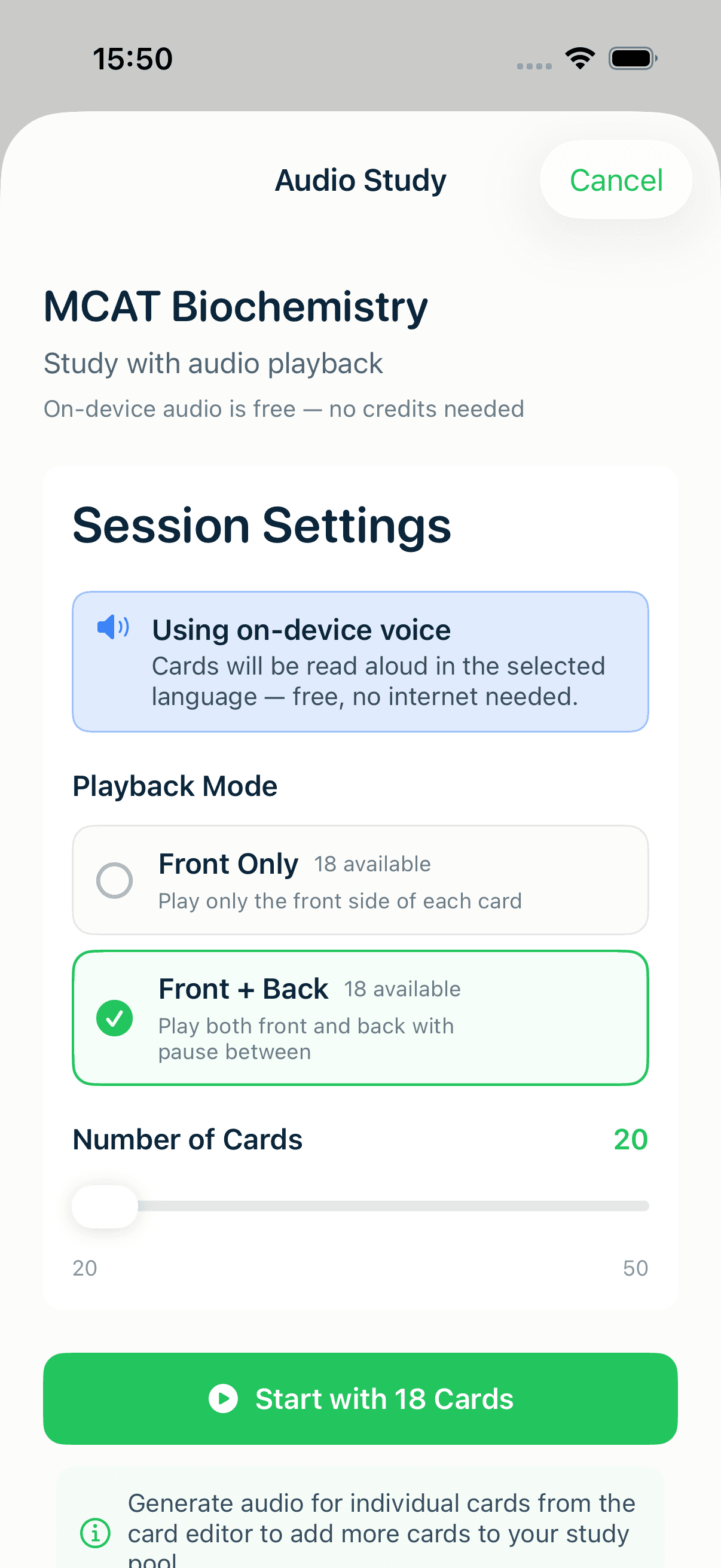
Two things to set before you start:
- Playback Mode — Front Only (good for fast recognition drills) or Front + Back (it reads the question, pauses, then reads the answer). Each mode shows how many of your cards are ready for it.
- Number of Cards — a slider for how long you want the session to run.
Notice the line up top: "On-device audio is free — no credits needed." That's the default path, and it's the one most people should use.
Step 2: Press play and go hands-free
Tap Start Audio Study and the playback screen takes over. From here you can put the phone in your pocket.
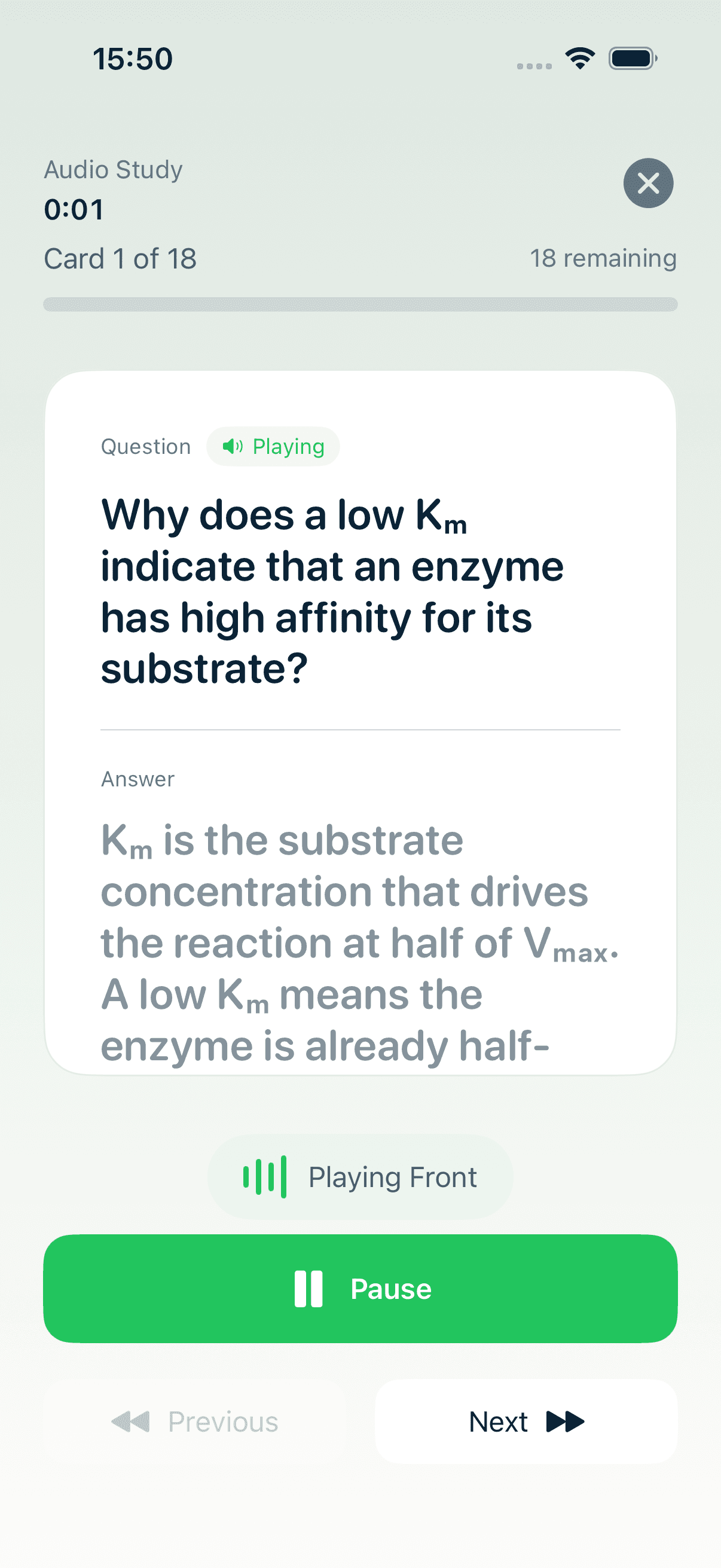
The controls are deliberately simple:
- Play / Pause — stop and resume any time.
- Previous / Next — jump back to re-hear a card, or skip ahead.
- A progress readout — "Card X of N" and how many remain — so you always know where you are.
It reads each card aloud and advances on its own. When the session ends you get a quick "Session Complete!" summary, and your progress is saved just like a normal review.
Pro Tip
Plug in headphones with playback controls (or use your watch). You can pause and skip without taking the phone out — which is what makes Audio Study genuinely usable on a run or a packed train.
Free voices vs. the premium voice
MintDeck has three voice options, and you can see them under Settings → Sound & Haptics → Voice & Sound:
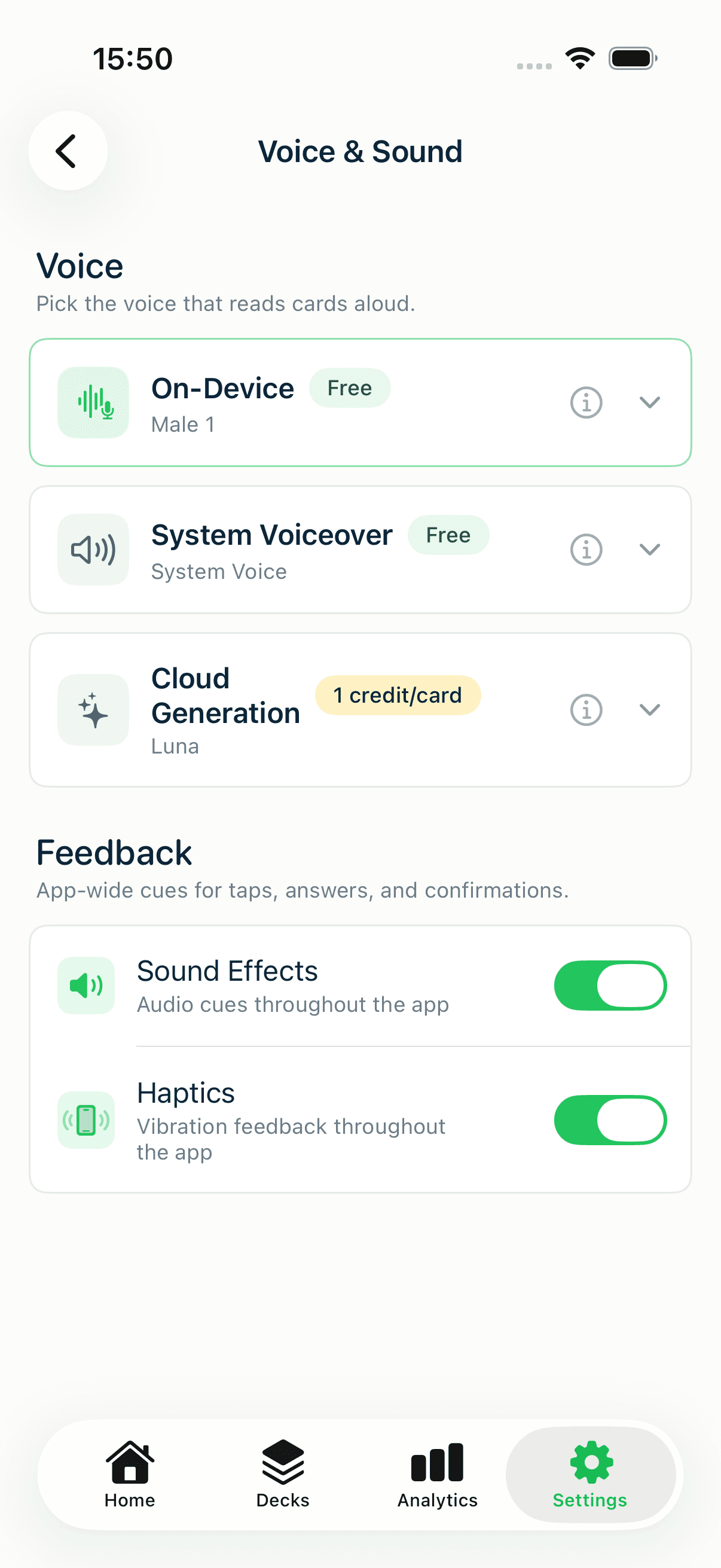
- On-Device — high-quality on-device AI voices, free, work offline (English, Korean, Spanish, Portuguese, and French).
- System Voiceover — your phone's built-in voices with automatic language detection across 70+ languages, free.
- Cloud Generation — the highest-quality, most natural voices, generated in the cloud. This is the only paid option, from 1 credit per card you generate it for.
The takeaway: Audio Study is free. The two on-device options cover the vast majority of decks with no credits at all. Cloud Generation is an optional upgrade for when you want the most natural pronunciation — and even then you only pay for the cards you generate. (For the full credit picture, see what's free and what costs credits.)
For language decks, pick a voice in the language you're learning — hearing correct pronunciation repeatedly is half the point. On-Device covers the five most common study languages for free; System Voiceover handles the long tail.
The best decks for audio
Audio shines on material that's verbal by nature:
- Vocabulary and language pairs — hear the word, recall the meaning (or flip the mode and produce the translation).
- Definitions and terminology — law, medicine, biology terms.
- Facts and Q&A — dates, names, quick conceptual checks.
It's less useful for cards that require seeing something — image-occlusion diagrams, heavy math, or anything where the answer is a picture. Use audio for the verbal decks and screen review for the visual ones; together they cover far more of your day.
Where to go next
Audio Study is only as good as the deck behind it, so build an audio-friendly one: import a vocabulary list with CSV import, bring an existing deck over with Anki import, or set up a language routine with the exam & language-learning guide. New to MintDeck? Start with the free study walkthrough.